19890709 "Three Dead and One Living"
Morning Moon Studio Sendai City Sendai
1. Language Stripped of Accent and Intonation (1989)
tape work: SAEGUSA Yukio
text: The Emperor’s Speeches over Three Years, published by Kobunsha
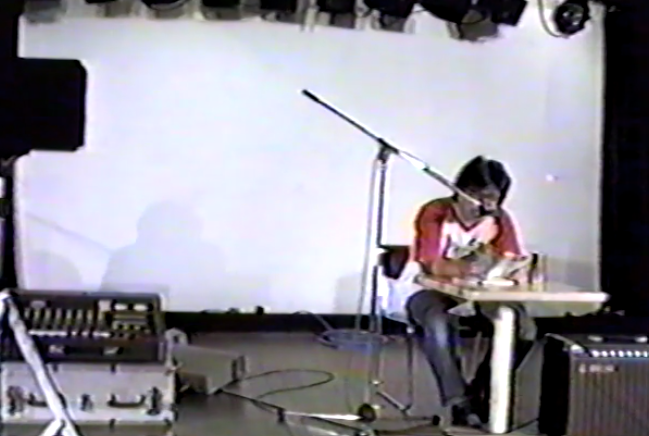
2. TAKIJI – Into the Electronic Sea (1989)
tape work: SUZUKI Takeo
text: KOBAYASHI Takiji, The Crab Cannery Ship, Iwanami Bunko
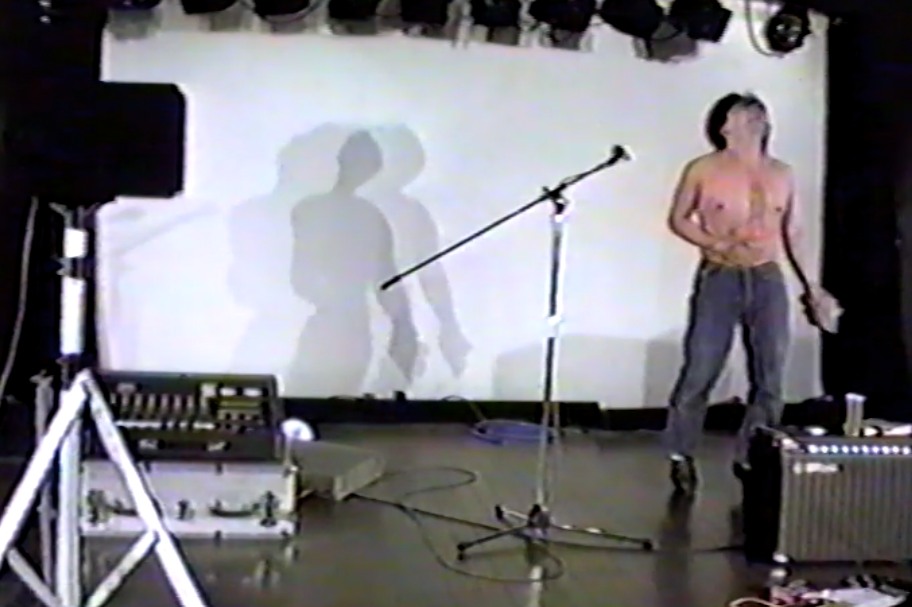
3. The Smell of Burning Electric Wires (1989)
tape work: SONODA Satoshi
text: HARA Tamiki, Summer Flower, Iwanami Bunko
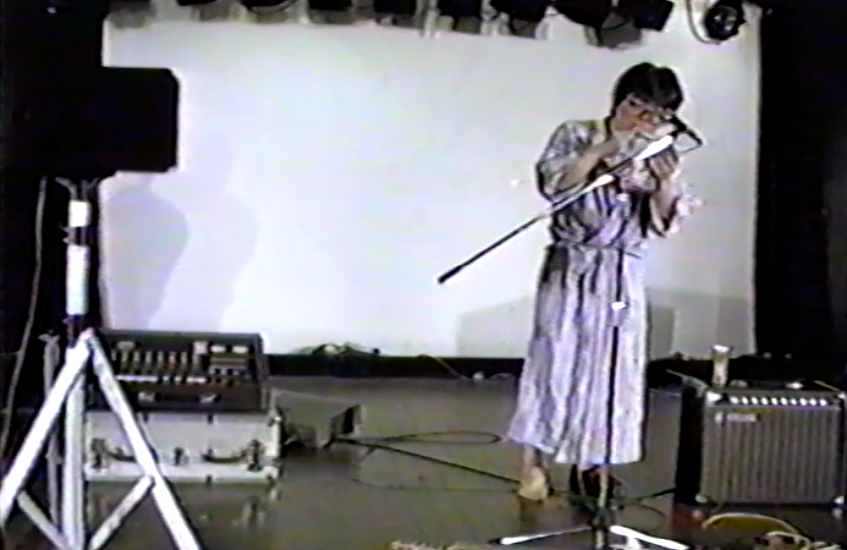
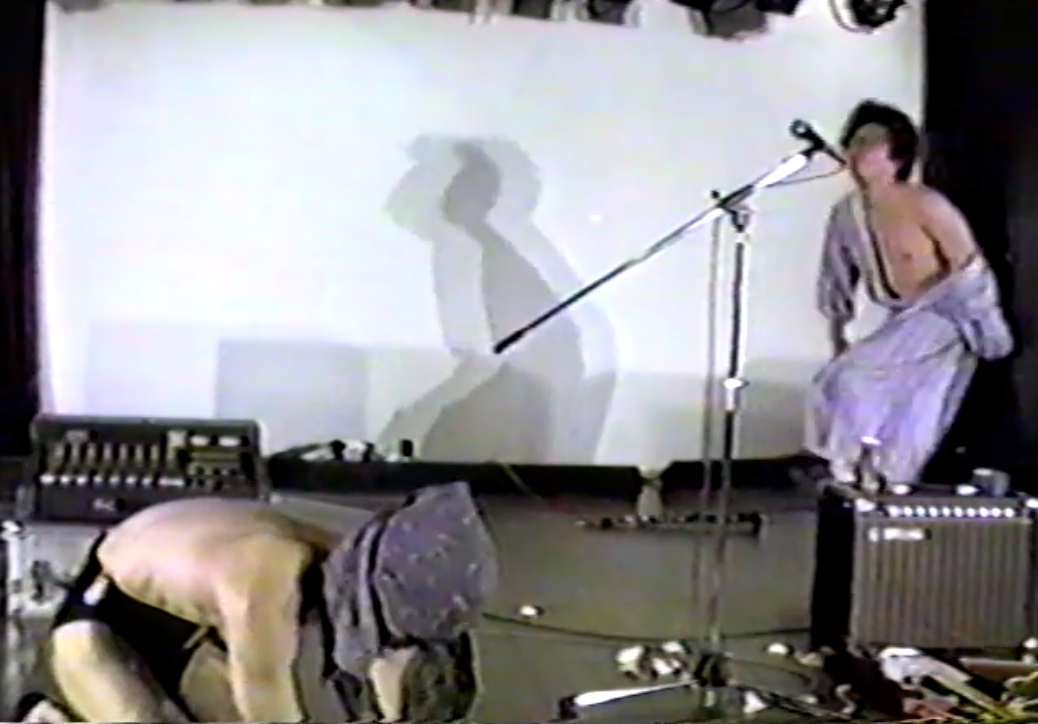
4. Three Dead and One Living: An Untimely Improvisation
dance: YANAKA Masanori
voice, action: ARAI Shin-ichi
A Very Brief Note
It is impossible to know when this text will be read: before the performance begins, while it is happening, after it has ended, or perhaps years later by someone collecting discarded paper and scrap.
So I think I have no choice but to write it in a way that is completely separate from the performance, yet also about it. In other words, I have to write it as part of the ongoing work of ARAI Shin-ichi.
I think this approach suits me perfectly.
I paint pictures, publish a small independent magazine called NIOH-DACHI Club, do things like today’s event, which is neither music nor dance but can only be described as a performance, and go to work for 208 hours a month, driven by the compulsion that although I don’t want to go, I cannot make a living if I don’t.
And yet, I find myself understanding less and less what is actually going on.
My sense of being alive is becoming increasingly faint, and I cannot help feeling that my body is moving on its own, like a machine.
Even when I am with other people, before I can think that we are not communicating, I have the feeling that I am simply talking away on my own.
Often, I don’t even know what I am trying to convey to the person I am talking to.
As a result, lately I have become capable of doing little more than taking notes, writing down what I have to do next, and then working my way through the list.
It is as if I am trying to tame myself.
Strangely enough, however, this way of living is perfectly suited to working in a company.
At work, what I am supposed to communicate to other people is clearly defined, so there is no need to think.
This sense of emptiness can be comfortable, too.
But unconsciously, it also makes people feel some enormous sense of loss, vaguely experienced as anxiety.
Is it a kind of sickness of existence?
If it is a sickness of existence, then it is structural, and a few minor adjustments will never solve it.
I would have to change my life fundamentally, or, well, fall in love or something.
In that sense, perhaps I am doing this kind of thing because I want to regard the act of negating something in response to something else, like an oxygen-starved goldfish opening and closing its mouth, as at least a somewhat positive act.
When I earn money, it means that I have done work that has some social value.
Because I proofread, a certain newspaper reaches its readers with somewhat fewer typographical errors, despite the occasional mistake.
That is the kind of socially useful activity for which I am paid.
But do people who earn a lot of money really do that much more work that has social value?
I would like to say NO, but in fact, that is exactly how things are.
Perhaps that is the limit of the society we live in, here and now.
Paradoxically, could we not say that unpaid acts are precisely what is most profoundly social?
They are called art, love, justice, or volunteer work.
They are not particularly fashionable; in other words, they are out of date.
But perhaps this society has so far avoided destruction only because such things still, barely, survive.
That is what I feel.
This is not nostalgia.
For me, a small act of resistance against this structural sickness is to rescue such unpaid acts from the history that is gradually burying them—to rescue, in other words, the things discarded as unnecessary by today’s society—and to place myself within that current.
Of the three dead men, 1st one is, needless to say, the person who has continuously shaped orthodox history and even imposes restrictions on the names we use every day.
2nd one could be said to have taken the possibility of an alternative history in the wrong direction.
But I am not criticizing them. I should add that what I am doing is experiencing history, and the present, all over again, in my own way.
This performance was made possible through the efforts of HATAKEYAMA Satoshi, NAGATSUKA Motoko, MIMURA Shuichiro, and KURIHARA Tadashi of the Forus Projects Department.
My thanks to them all.
July 1989
ARAI Shin-ichi
1989年7月9日
荒井真一
「三人の死者と一人の生者」
1. アクセントも強弱も抜き去られた言語(1989)
tape: 三枝由起夫
text: 『天皇陛下の三年間スピーチ』光文社刊
2. TAKIJI-電子の海へ(1989)
tape: 鈴木健雄
text: 小林多喜二『蟹工船』岩波文庫
3. ブスブストケムル電線ノニオイ(1989)
tape: ソノダサトシ
text: 原民喜『夏の花』岩波文庫
4. 三人の死者と一人の生者:反時代的な即興を用いた
dance: 谷中正典
voice, action: 荒井真一
ごく簡単な覚書
この文章はパフォーマンスが始まる前に、やっている最中に、終わったあとに、あるいは何年か後に廃品回収の人に、読まれるのかは特定でき ない。だからパフォーマンスとはまったく別でも、それについてでもあるという書き方、つまり荒井真一の一連の作業として書くしかないと思 う。ということが、絵を描いたり、『仁王立ち倶楽部』と いうミニコミを出したり、音楽でもダンスでもない今日のような、まさにパフォーマンスとしか言いようのないことをやったり、月に208時 間行きたくもないが行かないと食っていけないという強迫観念に駆られて仕事に行っている。自分にぴったりだと思う。
しかし、一体何が起こっているのかますます分からなくなり、自分が生きているという実感に希薄になって、まるで機械のように勝手に体が動 いているという気がしてならない。人と会っていても話が通じないと思う以前に、自分が何かを勝手にしゃべっているという感じで、いった い、いま話している相手に何を伝えようとしているのかすら、わからないことが多い。だから最近はメモをとってこれからやること、を書き出 してそれを消化していくという、自分で自分を手なずけるといった行動しか取れなくなっている。
しかし不思議なことに、こういう生き方は、会社などで生活するにはぴったりなのである。会社では、ぼくがほかの人に伝えるべきことははっ きりしていて、考える必要なんてないから。
この希薄さは心地よいものでもあるけれども、無意識のうちに何かとてつもない欠落感を漠然とした不安として、ぼくに感じさせる。
存在の病といった感じか? 存在の病であれば、構造的な病なのだから少々の手直しではらちがあかない、根本的に生活を変えるか、そうそう 恋愛でもするしかないだろう。
そういう意味で言えば、ぼくは酸欠の金魚が口をパクパクやるように何かに対応する否定を、少しは肯定的な行為に思いたくて、こういうこと をやっているのかもしれない。ぼくが、お金を得るのは社会的に意味のある仕事をしたということになっている。ぼくが校正をしているからこ そ某新聞は時々のミスはあるものの少しは誤植が減って読者に手渡される。そういう社会的な行為にたいしてお金が支払われるわけだ。
しかし、お金がたくさんもらえる人は、それだけたくさんの社会的に意味のある仕事をしているのだろうか?
「否」と言いたいところだけれど、まったくそのとおりなわけだ。それがいま、この社会の限界だろう。
逆説的ではあるが、無償の行為こそ優れて社会的であるともいえるのではないか? それは芸術といわれたり、愛といわれたり、正義といわれたり、ボランティアといわれたりして、あまりかっこよくないし、つまり時代遅れな んだけれど、本当はそういうものが、いまだかろうじて残っているから、この社会は破滅を免れているのではないか? そういう気がする。決 して懐古趣味からではなく埋もれていく歴史のなかにそういう無償の行為を、つまり今の社会において不要だということで切り捨てられたもの を救い出し、その流れのなかに自分を置いていくということが、ぼくにとって構造的な病へのささやかな抵抗なのだ。
そして三人の死者のうち最初の一人は言わずもがなのことであるが、正統派の歴史を綿々と形成し、毎日の名前にまでも制限を加えているの だ。
また、次の一人はもう一つの歴史の可能性をまずい方向に持っていったともいえる。
しかし、ぼくは批判するのではなく、自分の方法で歴史を、そして今を体験し直しているのだと付け加えておきます。
今回のパフォーマンスは、畠山敏、長束紀子、三村修一郎、フォーラス事業部の栗原正さんの尽力により上演が可能になりました。ありがとう ございました。
July. 1989
荒井真一